Artificial Intelligence (AI) is changing the way people work, study, communicate, and use technology. But not all AI systems work in the same way. Traditional AI has been used for years to recognize patterns, make predictions, and follow specific rules. AI agents, on the other hand, are a newer type of AI that can understand a goal, plan steps, use tools, and take actions with less human help.
This difference is becoming increasingly important in 2026 as businesses move from simple AI tools toward systems that can complete entire tasks.
So, AI agents vs traditional AI: what is the actual difference? And which one is better?
Let’s understand it in simple language.
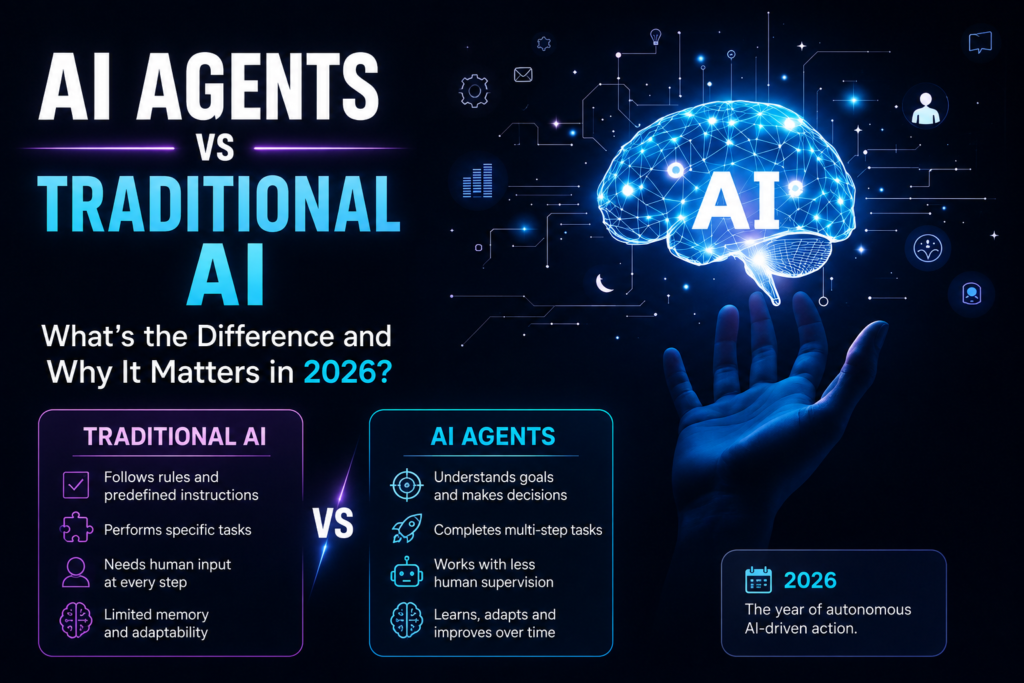
AI Agents vs Traditional AI: Quick Comparison
The easiest way to understand the difference is to imagine two students.
A traditional AI system is like a student who is given a specific question and answers it based on what it has learned.
An AI agent is like a student who is given a bigger goal and decides what steps are needed to complete it.
AI Agents Vs Traditional Ai
| Feature | Traditional AI | AI Agents |
|---|---|---|
| Main purpose | Predict, classify, generate or respond | Complete goals and tasks |
| Decision-making | Usually follows predefined instructions | Can plan and decide next steps |
| Autonomy | Low to moderate | High |
| Memory | Often limited | Can use short- or long-term memory |
| Tool usage | Usually limited | Can use APIs, databases and software |
| Human involvement | Often required | Can require less supervision |
| Tasks | Usually specific | Can handle multi-step tasks |
| Adaptability | Limited | More flexible |
| Example | Spam filter | AI research assistant |
| Main strength | Predictable results | Autonomous task completion |
The key difference is action and autonomy. Traditional AI mainly provides an output, while an AI agent can work toward a goal by taking multiple actions.
AI Agents Vs Traditional Agents What Is Traditional AI?
Traditional AI refers to AI systems designed to perform specific tasks using trained models, rules, or predefined processes.
For example, when your email automatically moves a suspicious message into the spam folder, AI may be helping identify whether the message looks like spam.
Similarly, an online shopping website may use AI to recommend products based on your previous activity.
Traditional AI is generally very useful when the problem is clearly defined.
For example:
- Detecting spam emails
- Predicting sales
- Recognizing faces
- Detecting fraud
- Recommending movies
- Translating text
- Classifying documents
These systems can be extremely powerful, but they usually work within the task they were designed for.
How Does Traditional AI Work?
A simplified traditional AI workflow looks like this:
Input → AI Model → Analysis → Output
For example, a bank may provide transaction data to an AI model. The model analyzes the information and predicts whether a transaction could be fraudulent.
The AI doesn’t necessarily decide what to do next on its own. A separate system or human may take action based on its result.
What Are AI Agents?
An AI agent is an AI system that can work toward a particular goal by deciding what actions to take.
Instead of simply answering a question, an AI agent can potentially break a large task into smaller steps.
Imagine telling an AI agent:
“Research five competitors, compare their products, create a report, and send it to my team.”
A traditional AI tool might help you write the report.
An AI agent could potentially:
- Search for competitors.
- Collect information.
- Compare the information.
- Organize the findings.
- Create the report.
- Send it through an approved communication tool.
This ability to plan and take multiple actions is one of the biggest differences between AI agents and traditional AI.
How Do AI Agents Work?
An AI agent usually follows a cycle rather than producing just one answer.
Goal → Plan → Use Tools → Take Action → Check Result → Continue or Finish
For example, suppose an AI agent is asked to find why a website’s traffic has decreased.
It might:
- Analyze website data.
- Check search performance.
- Look for technical problems.
- Compare previous traffic.
- Identify possible causes.
- Prepare recommendations.
The agent can decide what step should come next based on the results of the previous step.
Key Components of an AI Agent
Most AI agents can include several important components:
AI model: Helps the agent understand information and make decisions.
Memory: Helps it remember useful information or previous steps.
Tools: Allows it to interact with software, databases, APIs, search systems, or other applications.
Planning: Helps break a large goal into smaller tasks.
Actions: Allows the agent to perform tasks instead of only generating text.
Guardrails: Rules and controls that help prevent unwanted or unsafe actions.
AI Agents Vs Traditional AI: 10 Key Differences
The difference becomes clearer when we compare them directly.
AI Agents Vs Traditional Ai
1. Autonomy
Traditional AI generally waits for an input and produces an output.
AI agents can work toward a goal with greater independence.
2. Decision-Making
Traditional AI usually performs a defined task.
AI agents can decide which step should happen next.
3. Learning and Adaptability
Traditional AI models may be trained for specific patterns or tasks. AI Agents Vs Traditional
AI agents can adapt their actions based on the information they receive during a task.
4. Memory and Context
Many traditional AI applications have limited context.
AI agents can be designed with memory systems that help them maintain information across multiple steps or interactions.
5. Tool Usage
Traditional AI may simply provide an answer.
AI agents can potentially use external tools such as APIs, databases, calculators, browsers, or business software. AI Agents Vs Traditional
6. Human Intervention
Traditional AI often requires a person or another system to initiate the next action.
AI agents can automate more of the workflow.
7. Task Complexity
Traditional AI is usually excellent at specific tasks.
AI agents are designed to handle more complex, multi-step workflows.
8. Flexibility
Traditional AI generally operates within a defined purpose.
AI agents can potentially change their approach depending on the situation.
9. Output vs Action
This is perhaps the simplest difference.
Traditional AI often produces an output.
AI agents can produce an output and take an action.
10. Goal-Oriented Behavior
Traditional AI focuses on the requested operation.
AI agents can focus on achieving a broader goal.
: AI Agents Vs Traditional Ai A Real-World Example
Consider customer support.
A traditional AI chatbot might receive:
“Where is my order?”
It checks available information and replies:
“Your order is expected to arrive tomorrow.”
Now imagine an AI agent handling the same situation.
The customer says:
“My order hasn’t arrived and I need it urgently.”
The agent could potentially:
- Identify the order.
- Check delivery information.
- Contact or query the delivery system.
- Check whether the package is delayed.
- Look for available solutions.
- Create a support request if necessary.
- Inform the customer about the next step.
The important point is that the agent is not simply generating a response. It is working through a multi-step process.
Agentic AI vs Generative AI vs Traditional AI
These three terms are often confused.
| Technology | Main Purpose | Example |
|---|---|---|
| Traditional AI | Prediction, classification and specific tasks | Fraud detection |
| Generative AI | Creates new content | Writing an article |
| Agentic AI | Completes goals through multiple actions | Research and report agent |
Generative AI can create text, images, audio, code, and other content.
An AI agent can use generative AI as its “brain” while also using tools and taking actions.
So, not every generative AI system is an AI agent.
AI Agents Vs Traditional Ai
What Can AI Agents Do That Traditional AI Cannot?
AI agents are particularly useful for tasks that require several connected steps.
For example, an AI agent could potentially:
- Research information from different sources.
- Analyze business data.
- Create and update reports.
- Automate repetitive workflows.
- Interact with software tools.
- Monitor systems.
- Coordinate multiple tasks.
- Assist software developers.
- Handle customer-support workflows.
This doesn’t mean traditional AI is outdated. Instead, the two technologies are useful for different purposes.
AI Agent Use Cases in 2026
AI agents are becoming useful across many industries.
Customer Service
Agents can help handle customer requests, find information, and manage support workflows.
Software Development
AI agents can help developers understand requirements, write code, test applications, and identify errors.
Marketing
Marketing agents can assist with research, content planning, competitor analysis, and campaign workflows.
Finance
AI can help analyze financial information, identify unusual transactions, and support decision-making.
Cybersecurity
Agents can help monitor systems, investigate suspicious activity, and assist security teams.
Research
Research agents can gather information, organize findings, compare sources, and create summaries.
Benefits of AI Agents Over Traditional AI
AI agents can provide several advantages when used correctly.
Automation: They can automate multi-step processes instead of only individual tasks.
Productivity: Employees can spend less time on repetitive work.
Speed: Agents can perform multiple connected operations quickly.
Personalization: They can adjust actions based on individual requirements.
Scalability: Businesses can use AI to handle large numbers of routine workflows.
However, these benefits depend heavily on proper implementation.
Limitations and Risks of AI Agents
AI agents are powerful, but they are not perfect.
One major concern is incorrect decision-making. If an agent misunderstands a goal, it may take the wrong action.
Other risks include:
- AI hallucinations
- Privacy problems
- Security vulnerabilities
- Incorrect actions
- Excessive system permissions
- Higher computing costs
- Lack of human oversight
For example, giving an AI agent access to important company systems without proper restrictions could create serious problems.
AI Agent Security: Why Autonomy Changes the Risk
A traditional AI system might give an incorrect answer.
An AI agent could potentially act on an incorrect answer.
That’s why AI agents need proper security controls, including:
- Limited permissions
- Human approval for sensitive actions
- Activity monitoring
- Data protection
- Testing
- Clear operating rules
The more freedom an AI agent has, the more important these controls become.
When Should You Use Traditional AI Instead of an AI Agent?
AI Agents Vs Traditional Ai
An AI agent isn’t automatically better.
Traditional AI may be the better choice when you need a predictable and focused solution.
For example:
| Requirement | Better Choice |
|---|---|
| Spam detection | Traditional AI |
| Sales prediction | Traditional AI |
| Product recommendation | Traditional AI |
| Simple content generation | Generative AI |
| Multi-step research | AI Agent |
| Workflow automation | AI Agent |
| Complex customer support | AI Agent |
| Autonomous software tasks | AI Agent |
The right technology depends on the problem.
If a task is simple, predictable, and clearly defined, traditional AI can be more efficient.
If the task requires planning, multiple decisions, tools, and actions, an AI agent may be more suitable.
How Businesses Can Prepare for AI Agents in 2026
Businesses should not adopt AI agents simply because they are popular.
A better approach is to first identify repetitive workflows where automation can create real value.
Companies should:
- Identify suitable tasks.
- Start with low-risk workflows.
- Give agents only necessary permissions.
- Set clear rules and limits.
- Monitor performance.
- Keep humans involved in important decisions.
- Measure time, cost, accuracy, and business results.
This approach can make AI adoption safer and more useful.
The Future of AI Agents Vs Traditional AI
The future is unlikely to be about AI agents replacing every traditional AI system.
Instead, both technologies will probably work together.
Traditional AI can continue handling prediction, classification, detection, and other specialized tasks.
AI agents can sit above these systems and coordinate different tools to complete larger workflows.
For example, an AI agent could use a traditional fraud-detection model, a database, an analytics system, and a communication platform to complete a financial investigation.
This combination could make AI systems much more useful.
AI Agents Vs Traditional AI: Which One Is Better?
There is no single winner.
Traditional AI is better for focused, predictable tasks.
AI agents are better for complex, multi-step tasks that require planning and action.
The biggest change in 2026 is that AI is moving beyond simply answering questions. AI systems are increasingly being designed to understand goals, make plans, use tools, and complete tasks.
For students, professionals, and businesses, understanding this difference is important because AI agents are likely to become a major part of how digital work is performed in the coming years.
Frequently Asked Questions
Are AI agents better than traditional AI?
Not always. Traditional AI is often better for specific and predictable tasks, while AI agents are more useful for complex, multi-step workflows. AI Agents Vs Traditional
AI Agents Vs Traditional
What is the main difference between AI agents and traditional AI?
Traditional AI generally performs a specific task and provides an output. AI agents can work toward a goal by planning steps, using tools, and taking actions.
Can AI agents replace traditional AI systems?
Usually, they are more likely to work alongside traditional AI rather than completely replace it. Traditional AI remains useful for specialized prediction and classification tasks.
Are ChatGPT and other generative AI tools AI agents?
A generative AI chatbot is not automatically an AI agent. An AI agent typically has additional capabilities such as planning, tool use, memory, and autonomous action.
What are examples of AI agents in 2026?
Examples include research agents, coding agents, customer-support agents, marketing automation agents, and business workflow agents.
What are the risks of AI agents?
Major risks include incorrect decisions, hallucinations, privacy issues, security vulnerabilities, excessive permissions, and lack of human oversight.
What is the difference between agentic AI and generative AI?
Generative AI focuses mainly on creating content, while agentic AI focuses on achieving goals through planning, tool use, and actions. AI Agents Vs Traditional
Can AI agents work without human intervention?
Some AI agents can perform tasks with limited human involvement, but sensitive or high-risk activities should generally include human oversight.
What will AI agents look like in the future?
AI agents are likely to become more capable of coordinating software, handling workflows, collaborating with humans, and completing complex digital tasks while operating within controlled boundaries.